Wheat Flour Mill Plant Investment Cost in Uzbekistan
Uzbekistan is a major grain-producing region in Central Asia, attracting many investors to the flour milling business. Investment in a flour mill involves more than just equipment costs; raw material characteristics, infrastructure and working capital all affect project expenditure and returns. This article introduces various local grains for processing, breaks down flour mill investment costs by production capacity, and explains capacity calculation methods to support preliminary project planning for flour mills.
Overview of Raw Materials for Flour Milling in Uzbekistan
Wheat serves as the primary grain for flour production in Uzbekistan. The country also produces rye, barley, corn and other grains locally. Flour milling lines can switch between raw materials according to client requirements to produce different types of powder products.
-
Wheat: The staple grain of the country, accounting for over 70% of Uzbekistan’s total grain output. Supply is highly seasonal. Local wheat is mostly medium-gluten, suitable for general-purpose flour for daily consumption. High-gluten wheat needs to be imported for bread and bakery flour. Grain purchased locally often contains sand, soil and weed seeds, with impurity levels generally at 2%–4% and moisture fluctuating from 11.5% to 14.5%. A complete cleaning and tempering process is therefore required.
-
Rye: Grown locally, making up roughly 5% of total grain planting area. Rye flour is used for specialty bread and traditional staple foods with steady market demand. Rye has a hard texture, requiring separate adjustments to cleaning and milling parameters. Its flour extraction rate is slightly lower than wheat, at about 68%–71%.
-
Barley: Accounts for approximately 10% of grain planting. It is used for barley flour, multi-grain powder, and also for the feed industry. Barley features heavy husks, which represent 12%–18% of grain weight, demanding a high-performance pre-shelling and cleaning process.
-
Corn: Ample local supply, accounting for around 12% of total grain output. It can be processed into corn flour and corn grits for food and feed markets. Corn contains 4%–6% fat and tends to turn rancid during storage, requiring different warehousing conditions from wheat. Safe storage moisture must be kept below 13%.
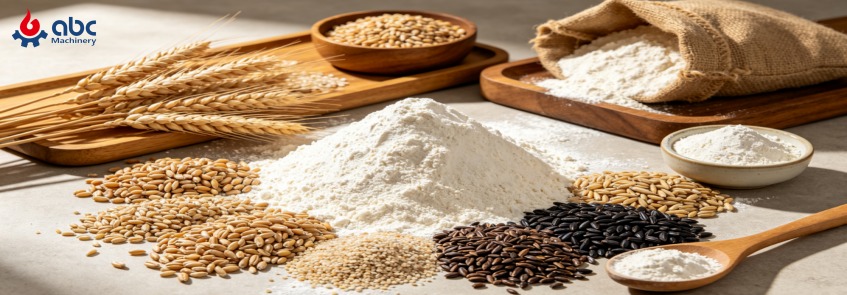
Grain Raw Material And Finished Flour for Flour Mill
Different grains vary greatly in impurities and physical properties. ABC Machinery can evaluate project location, raw material supply, target flour varieties and planned capacity, break down milling equipment costs, fixed asset investment and working capital for flour mills, customize flour milling line solutions and provide project quotations. Feel free to click the button below to contact us. ABC Machinery’s engineers are available 24/7 for free consultation.

Cost Breakdown of Flour Mill Projects by Production Capacity
The investment cost of a flour mill in Uzbekistan cannot be simplified to the price of flour milling equipment alone. A complete flour processing project generally consists of three major components: flour milling equipment cost, fixed asset investment and working capital. Combined with local construction market conditions and industry experience, the following cost ranges can be used for preliminary estimation.
Flour Milling Making Equipment Cost
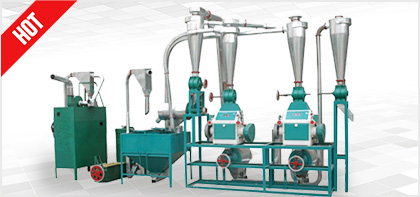
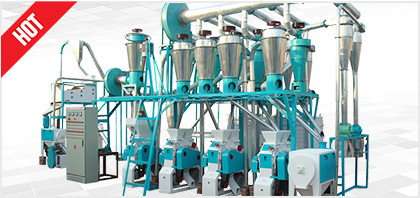
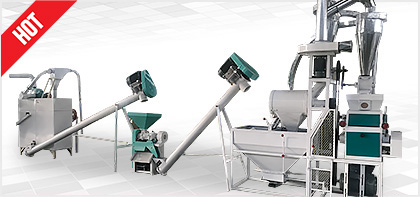
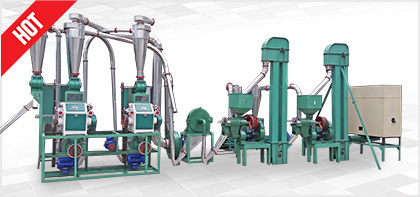
Flour milling equipment constitutes the core investment of the project. The full set of flour processing machinery includes wheat cleaning, stone removal, magnetic separation, tempering, milling, sifting, flour purification, blending, packaging, conveying, dust removal and automatic control systems. Based on common mill scales in Uzbekistan, estimated equipment costs for flour processing lines are as follows:
-
50 tons/day flour milling line: USD 28,000–32,000. A small-scale fully automatic milling configuration with integrated wheat cleaning, tempering, milling, sifting, dust removal and automatic packaging units.
-
100 tons/day flour milling line: USD 55,000–62,000. The cost-effective mainstream mid-range automatic flour milling line in Uzbekistan. It enables refined separation of flour, semolina and bran, and can produce multiple grades of consumer flour.
-
200 tons/day flour milling line: USD 110,000–125,000. Supports 24-hour continuous stable production and can be customized for high-gluten, medium-gluten and low-gluten flour varieties.
Flour milling equipment usually accounts for around 45%–50% of total fixed asset investment.
Fixed Asset Investment for Flour Mills
Fixed asset investment covers not only milling equipment but also building construction, equipment foundations, warehousing systems, utility works, installation & commissioning and site supporting facilities. This is a large portion of flour mill investment, representing 50%–55% of total fixed asset investment.
Reference investment ranges:
-
50 tons/day flour mill project: USD 30,000–35,000. Equipped with small raw material and finished product warehouses, requiring limited workshop space and short civil construction cycles.
-
100 tons/day flour mill project: USD 65,000–72,000. Separate raw grain storage zones and finished product warehouses allow stock segregation of raw materials and finished goods to support medium-scale inventory turnover.
-
200 tons/day project: USD 130,000–145,000. Large-capacity wheat storage system plus complete power distribution, fire protection and site roads to support long-term bulk raw material storage.
Workshop construction, warehousing, installation and commissioning take a major share. For a 100 tons/day flour mill project, workshop and warehousing account for 30%–40% of fixed asset investment, while equipment foundations, utility works, installation and commissioning account for 15%–25%.
Flour Mill Plant Working Capital
Working capital covers raw grain procurement, packaging materials, staff salaries, energy costs, transportation, quality testing and expenses during trial production. Required working capital depends on capacity, purchasing cycles and inventory levels, and is generally recommended at 30%–40% of fixed asset investment.
Reference ranges:
-
50 tons/day project: USD 18,000–22,000. Covers short-term raw material procurement and daily operation turnover.
-
100 tons/day project: USD 38,000–45,000. Enables seasonal bulk wheat purchasing to lock in raw material costs.
-
200 tons/day project: USD 75,000–85,000. Supports large-scale stockpiling to mitigate seasonal wheat price fluctuations and secure year-round stable production.
For medium-sized flour mills, raw material procurement is the largest working capital expense, accounting for 40%–50% of mill operating funds. Packaging, labor and energy costs make up 20%–30%.
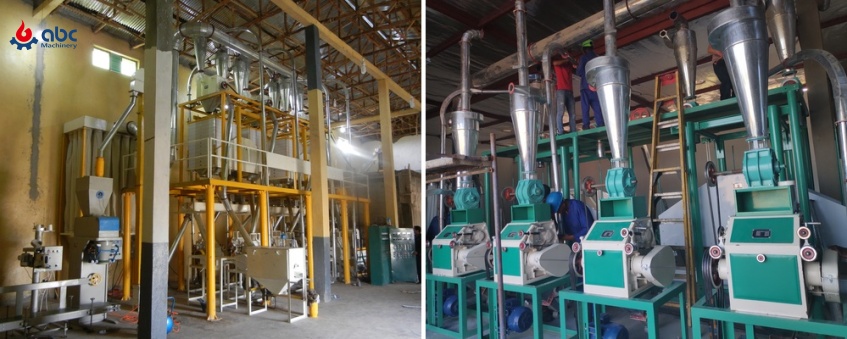
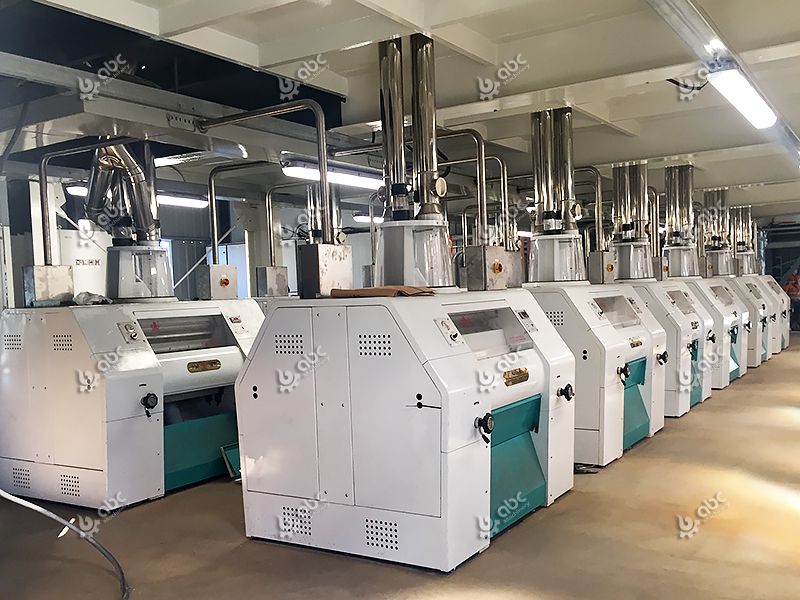
Turnkey Wheat Flour Mill Equipment Inside Production Workshop
Reference Formula for Capacity Planning
When planning capacity, flour mill investors need to calculate the stable annual raw material supply and annual working days. The formulas below can be used for preliminary estimation:
Annual processable quantity ≈ Annual stable raw material supply × Raw material availability rate Daily processing capacity of equipment ≈ Annual processable quantity ÷ Annual working days
Based on local conditions in Uzbekistan, recommended parameters for preliminary calculation:
-
Raw material availability rate: 85%–90%
-
Annual working days: 300–320 days
-
Flour extraction rate: 72%–75%
Calculation example: If a flour mill project has a stable annual wheat supply of 27,000 tons and the raw material availability rate is 88%, the annual processable quantity is calculated as: 27,000 × 88% = 23,760 tons. If the mill operates 310 days per year, the required daily equipment capacity is: 23,760 ÷ 310 ≈ 76.6 tons/day. At the preliminary stage, this flour mill project may consider installing an 80–100 tons/day flour milling line.

The above figures are for preliminary project estimation only. Actual investment is affected by project location, workshop conditions, milling equipment configuration, automation level, local labor & material prices and financing costs. The formulas serve merely as a reference for capacity estimation and do not constitute fixed investment amounts or recommended production capacities.
Overseas Flour Mill Investment | ABC Machinery – Complete Grain Milling Equipment Supplier
ABC Machinery has delivered flour mill projects across many countries globally, with solid knowledge of grain characteristics and plant construction requirements in Central Asia and worldwide. We do not only supply milling equipment but provide one-stop flour mill solutions: from preliminary project assessment and process customization, to equipment manufacturing, on-site installation & commissioning, staff training, plus spare parts supply and technical support in later operation.
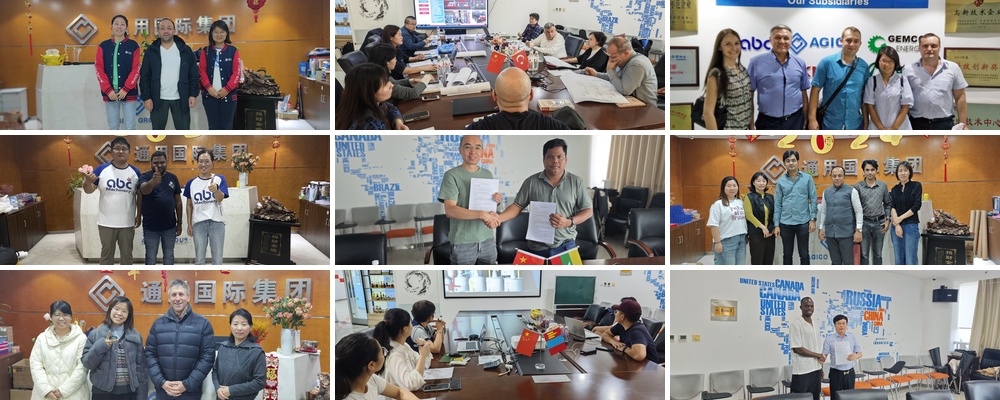
International Client Cooperation Meetings for Turnkey Flour Mill Plant
Our production lines can flexibly process wheat, rye, barley and corn to produce a wide range of powder products. The equipment features stable performance and controlled energy consumption, paired with intelligent control systems to raise flour yield and reduce raw material losses. Remote technical support is available after project handover to guarantee continuous stable flour mill operation. Whatever the production scale, ABC Machinery can customize feasible milling solutions matching your budget, raw material conditions and product requirements.
We receive enquiries in English, Español (Spanish), Русский язык (Russian), Français (French) and العربية (Arabic). Our professional team will reply to you within one business day. Please feel FREE to contact us!