Custom Wheat Milling Process for Your Flour Mill Plant
In the modern grain processing industry, wheat milling is no longer a simple grinding process, but a systematic project integrating process design, wheat flour machinery configuration, energy consumption control, product customization and market adaptation. This article focuses on the complete wheat milling process, combined with different production capacity scales above 5–200TPD, to provide industry investors with practically implementable process configuration and investment reference schemes.

Complete Wheat Flour Milling Process
The complete wheat milling process consists of multiple key links, each of which directly affects the quality and production cost of wheat flour, and is also related to the investment cost, equipment selection and core quality control needs of the wheat flour plant. The details are as follows:
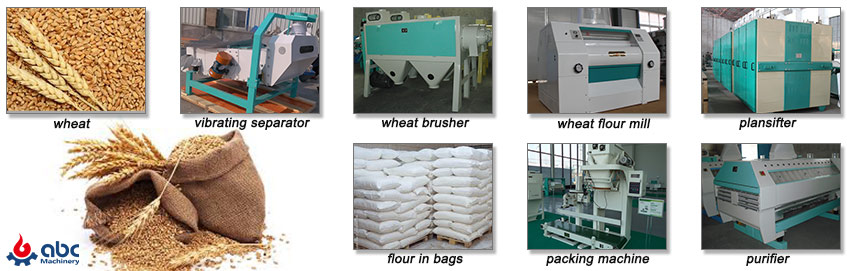
Profitable Wheat Flour Mill Plant Flow Chart
Cleaning Section
-
Incomplete cleaning will accelerate the wear of grinding rolls, damage of screens, reduce the flour extraction rate and whiteness, and even cause potential safety hazards of the flour machine.
-
Adopt a multi-stage combined cleaning process of primary cleaning sieve → vibrating sieve → destoner → magnetic separator → air separation, equipped with online automatic monitoring devices, with impurity detection frequency not less than 2 times per hour, to ensure the stable qualification of cleaned wheat entering the mill of the flour mill plant.
Conditioning & Tempering
-
Low moisture will easily cause bran breakage, increased ash content and higher power consumption of the wheat processing plant; high moisture will easily lead to material bonding and difficult sieving, and raw material loss can increase by 1%–3%.
-
Hard wheat: tempering moisture 14.5%–16.5%; soft wheat: tempering moisture 13.5%–15.0%, combined with online moisture detector, dynamically adjust according to wheat bulk density, hardness and grinding status to achieve stable tempering for the wheat mill.
Milling Section
-
Adopt the combination of skin milling, slag milling, core milling and purification systems, with multiple grinding and classification sieving. Adjust the number of grinding passes, grinding roll slope and gap according to the product positioning such as general flour and special flour, so as to realize fine stripping and classification purification of endosperm in the flour mill.
-
Special Grade 1 flour: ash content ≤0.55%; general standard flour: ash content ≤1.10%; wet gluten content of steamed bun flour and dumpling flour is usually 26%–32%, and that of bread flour can reach more than 30%. The rational configuration of the flour making machine in this section is crucial to product quality.
Sifting, Blending & Packaging
-
Insufficient sieving efficiency will lead to high ash content and quality fluctuation; manual packaging in the wheat milling process is inefficient, with large errors and high labor costs.
-
Adopt the combined process of high square plansifter + air separation purification, equipped with automatic flour blending system and packaging line; the measurement error of 25kg specification packaging is controlled within ±0.2kg, meeting the general industry standards of the flour processing plant.
Through the refined configuration of each section of the wheat flour production line, on the premise of complying with the national wheat flour quality standards, the flour extraction rate can be stabilized, energy consumption can be controlled, and the return on project investment can be improved. Unsure about the process parameters of your target products? Welcome to click the button below at any time to contact us and get free professional process calculation services!

5–200+TPD Typical Wheat Flour Milling Plant Configurations
In the modern flour mill investment, the production capacity scale directly determines the process complexity, automation level, investment amount and market coverage. For different investment entities of wheat flour processing plants, ABC Machinery can customize exclusive implementable schemes based on more than 20 years of industry practical experience.
5–50TPD Wheat Flour Mill
-
Core customer group: local township grain stations, small grain and oil processors, township canteens, and surrounding small pasta workshops.
-
Small-scale operation and management are simple, with low entry threshold, and the failure shutdown rate of wheat flour machine is controlled within 0.3% (the average failure shutdown rate of small-scale equipment in the industry is 0.8%).
-
Investment return reference: calculated by 70% capacity utilization rate, the investment payback period of the wheat flour processing plant is about 2–3 years.
-
ABC Machinery provides full-process technical guidance, one-stop service from the installation of wheat flour machinery to commissioning and production, laying a solid foundation for the subsequent expansion of the wheat flour processing plant.
50–200TPD Wheat Flour Mill
-
Core customer group: regional grain distributors, chain baking enterprises, local flour brands, and small and medium-sized food processing plants in surrounding cities.
-
The production capacity and cost of the wheat flour production line achieve the optimal balance, which can cover more than 80% of the flour demand in the region. It can not only sell general flour in large quantities, but also increase prices through special flour, which is the core layout for breaking through the regional market.
-
Investment return reference: calculated by 70% capacity utilization rate, the investment payback period of the wheat flour processing plant is about 3–4 years.
-
ABC Machinery's global after-sales response time is within 24 hours, and the fault resolution efficiency is 45% higher than the global industry average.
200TPD+Wheat Flour Mill
-
Core customer group: large grain groups, food industry giants, export-oriented flour enterprises, and international flour purchasers.
-
Investment return reference: the investment payback period is about 4–6 years, and the income level can be improved by virtue of scale effect and high-value-added products with the support of the flour mill production line.
-
ABC Machinery is equipped with an international technical team, providing 24-hour remote + on-site services, and offering in-depth guidance such as operation optimization and quality control upgrading for the wheat flour mill plant.
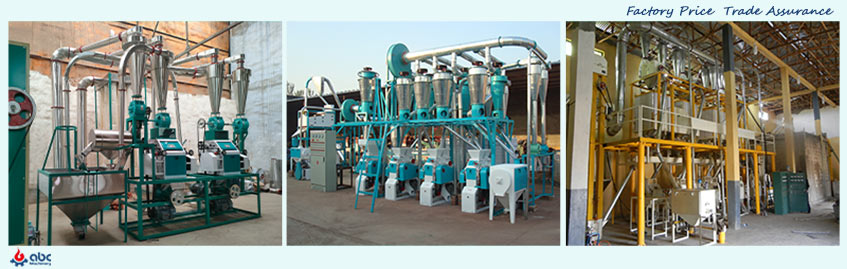
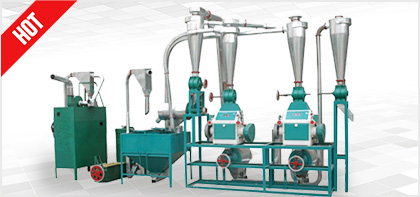
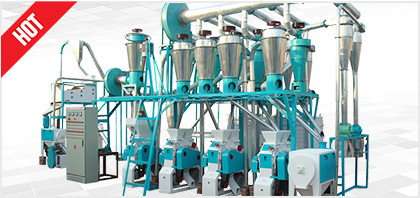
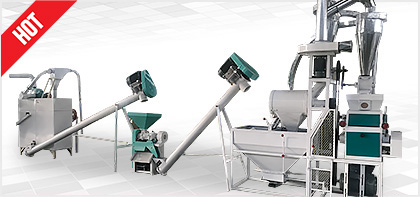
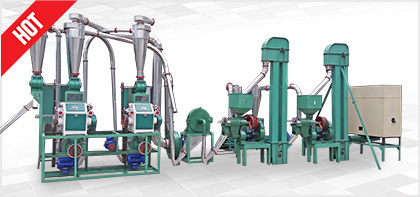
Different Scale of Profitable Wheat Flour Mill Plant
Benefits of Choosing ABC Machinery for Your Wheat Milling Plant
Partnering with ABC Machinery elevates your wheat milling operation through optimized processing technology and maximized return on investment, with core advantages as follows:
-
8%–12% lower power consumption per ton of wheat, 12%–18% lower annual energy costs; modular design cuts retrofit investment by 25%–35% for your flour plant.
-
Tailored to your needs, boosting high-grade flour yield by 3%–5% and reducing per-ton processing costs by 5%–8% for the wheat milling process.
-
Regular optimization boosts capacity by 5%–10% and cuts energy use by another 3%–5% for your wheat milling operation.
-
Adapted to local standards (GB/EC/FDA/CAC) and scenarios, avoiding investment waste for your wheat flour mill plant.
-
Wheat Flour Equipment meets international standards, with key indicators outperforming global averages.
-
Pre-sales risk mitigation, in-sales fast commissioning, 24-hour after-sales support for your wheat milling project.
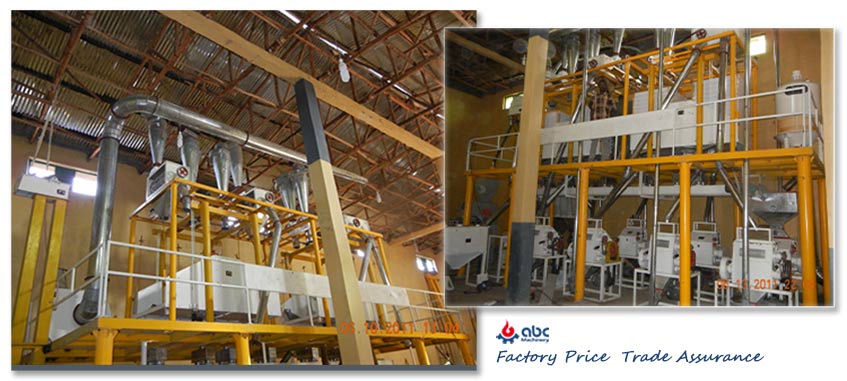
Successful Wheat Flour Plant Project for Sale
We receive enquiries in English, Español (Spanish), Русский язык (Russian), Français (French) and العربية (Arabic). Our professional team will reply to you within one business day. Please feel FREE to contact us!