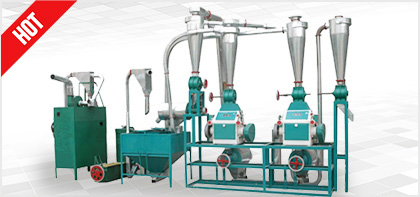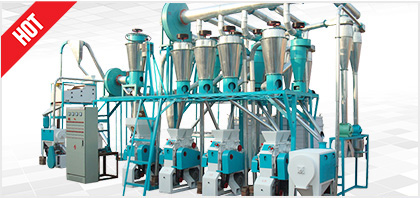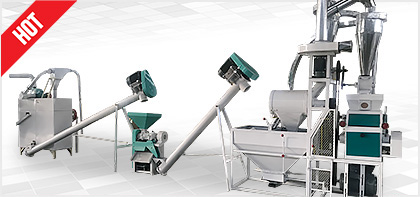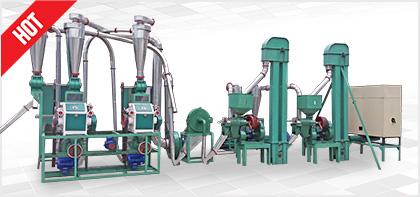
60 TPD Flour Milling Equipment
A 60 TPD flour mill plant processes 60 tonnes of raw wheat every 24 hours; it does not produce 60 tonnes of flour. At a 72% to 76% extraction rate the flour output is 43 to 46 tonnes a day, with bran, middlings and germ making up the rest, and a 20-hour effective shift puts the hourly duty at 3.0 t/h. Get that distinction wrong and the whole line comes out one size small.
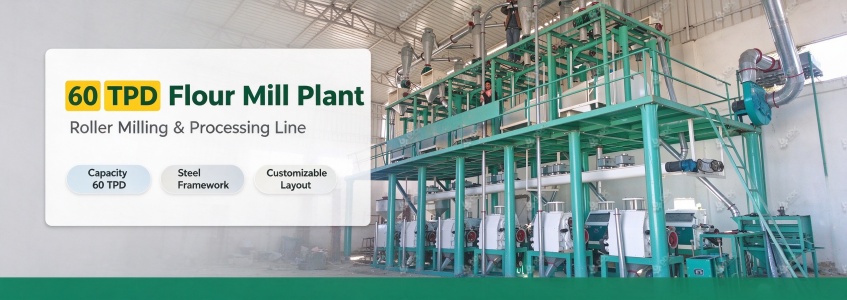
This is the entry level of a proper commercial flour mill: above 30 or 40 TPD, below 100 TPD. The difference from 40 TPD is not only tonnage. A 40 TPD line usually runs one destoner and 7 or 8 roller mills; at 60 TPD the destoner has to go parallel or step up, the mill count rises to 9 or 12, and the building needs an extra floor or an extra bay. This is where a set of machines becomes a flour mill project — process design, structure and circuit grouping all have to be done for this capacity instead of copied from the rung below.Six kinds of buyer end up at this size: a new small-to-mid mill, a grain mill running coarse grains alongside wheat, a grain cooperative building its own processing, a noodle or steamed-bread factory adding a captive milling section, a grain trader moving from trading into processing, and an existing 30 to 40 TPD plant expanding.
2. Flour Mill Making Line Composition and Process Flow
The complete flour mill machinery is arranged in three sections: cleaning, milling, and post-milling. Product enters at the top floor and falls by gravity through each level, with no pneumatic lifting in between, and that is the reason a 60 TPD plant belongs in a multi-storey steel structure rather than a single-storey shed.
2.1 Cleaning Section
The cleaning section sets the ceiling for every grain milling machine downstream. A mini flour mill can run a single-pass cleaning section and get away with it; 60 TPD cannot. Skip it and the rolls groove within weeks, sieve frames blind over and ash figures drift above spec — all of it surfacing later, all of it rooted here.
-
Vibrating screen (pre-cleaning): removes straw, large impurities and light matter on two decks. Sized at 2.5 to 3.75 t/h, or 1.2 to 1.5 times the 3.0 t/h duty.
-
Destoner: removes stones of the same size as wheat. The TQSF40 covers 1.5 to 2.5 t/h and the TQSF50 starts at 4.0 t/h, so a 3.0 t/h duty sits between them; the standard answer is two TQSF40 units in parallel at 60% load each.
-
Scourer: strips dust and bran from the wheat surface and knocks down infested kernels. Intensity is adjustable and broken-kernel rate is the figure to watch.
-
Aspirator: separates light impurities and insect-damaged grain by terminal velocity, working with the vibrating screen.
-
Magnetic separator: removes tramp iron, fitted after scouring and before the mill to protect rolls and sieve frames.
-
Dampener and tempering bins: tempering runs 18 to 24 hours, with each bin sized on 8 to 12 hours of throughput — 24 to 36 tonnes at this capacity — and two bins alternating.
-
Lifting and dust collection: bucket elevators, airlock valves and a pulse-jet bag filter. Flour dust is explosive, so the filter needs an explosion vent and antistatic bags.
2.2 Milling Section
The milling section is the most expensive part of the line and the part that decides grade. The mainstream flour mill process here is 4 break, 5 reduction and 1 scratch (10 passages) or 4 break, 4 reduction and 1 scratch (9 passages); the longer flow adds a reduction passage, separates middlings more finely and makes a high-grade flour easier to hold. An atta flour mill would run shorter than either, with fewer reduction passages and a coarser sieve set.
-
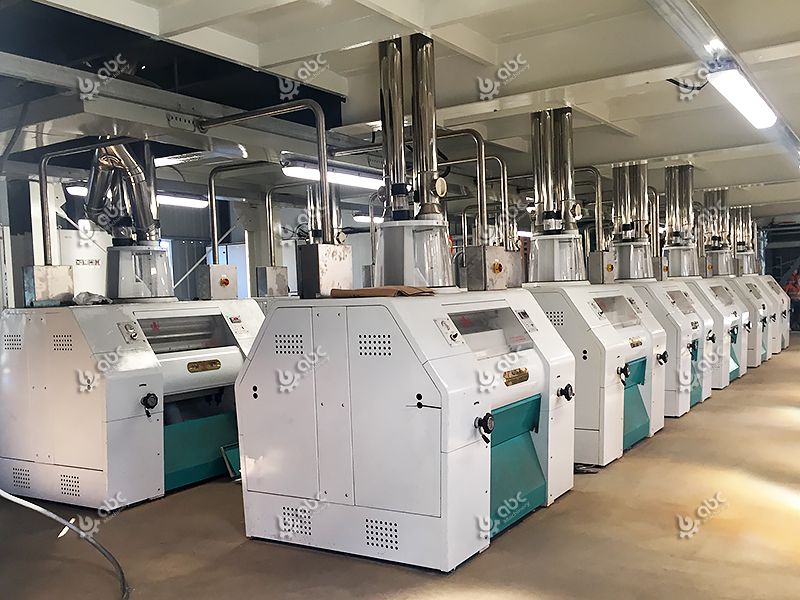
Roller mills: break rolls open the wheat, reduction rolls grind middlings, scratch rolls handle bran-bearing stock. Roll flute and gap differ between them and they are not interchangeable. Count at this capacity runs 9 to 12.
-
Plansifters: grading and flour release, 4 or 5 units. Sieve area has to match roll output; undersize it and the mills can only run below capacity.
-
Purifiers: 2 or 3 units, separating middlings by quality. A line without them still makes flour, but not a stable grade.
-
Bran finisher: recovers flour still adhering to bran, raising extraction and lowering starch in the bran, 1 or 2 units.
The flour mill machine count is calculated, not chosen. The basis is 6 to 8 mm of roll contact length per kg/h of wheat; a 3.0 t/h duty is 3,000 kg/h and needs 18,000 to 24,000 mm. One FMFQ10x2A wheat flour milling machine carries two pairs of 1,000 mm rolls, or 2,000 mm, which divides to 9 to 12 machines.
A purifier does not raise output; it changes how much high-grade flour a given wheat will yield. Without one, middlings go to the mill mixed and good stock leaves with bran-bearing stock. With one, the purest particles take a separate passage and ash comes down. That also explains a question buyers ask constantly: two lines of identical capacity can differ hugely in price because the difference is in the flow, not in the tonnage.
2.3 Post-Milling Section
Post-milling decides how fast the plant can ship, and no wheat milling machinery upstream helps if packing lags. Let the mill section run full while packing lags and the real output is set by the bagging rate.
-
Final check sieve: the last guard before the flour bin, catching anything a torn sieve frame lets through.
-
Automatic net weighing scale: 25 kg bags at a net pace of 120 bags an hour, one every 30 seconds, with a rated capacity of at least 144 bags an hour.
-
Bag closer: interlocked with the scale, including gusset folding and thread supply.
-
Finished bins and bran route: bins sized on one or two days of output; bran and middlings on a separate route, never sharing a screw with flour.
-
Dust system and PLC cabinet: collection sized on the number of suction points; circuits split by section and roller mills grouped in rows.
2.4 The Whole Flow in One Line
Wheat intake, cleaning (screen, destoner, scourer, magnet), tempering for 18 to 24 hours, grinding and sifting (break rolls open the wheat, reduction rolls grind, plansifters grade, purifiers clean up middlings), graded flour into separate bins, automatic packing. The flow relies on floor height throughout, with stock entering at the top and stepping down level by level, which is why a 60 TPD flour milling plant suits a multi-storey steel frame and not a single-storey shed.
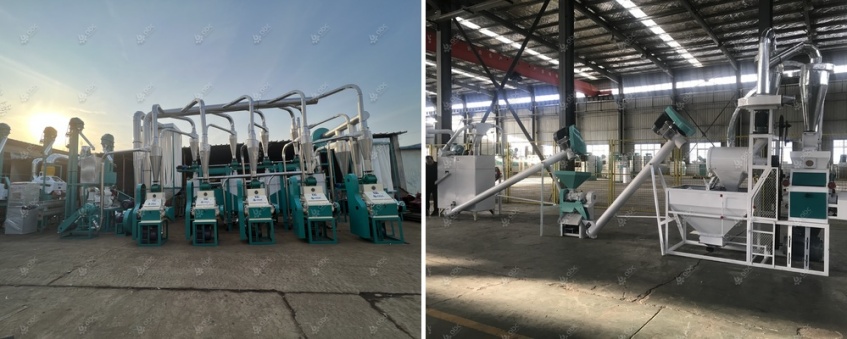
Complete Flour Mill Plant for Sale

3. Main Technical Parameters in Flour Mill Plant Project
The table below is the reference set that belongs in a flour mill project report, covering the whole wheat flour machinery scope. Rows marked as derived come from published data scaled by capacity ratio, with the arithmetic in the notes so it can be verified at the negotiating table.
Table 1. Main technical parameters at 60 TPD
|
Item |
Reference |
Note |
|---|---|---|
| Wheat intake | 60 t / 24 h | 3.0 t/h on a 20-hour shift; 2.5 t/h over 24 hours |
| Total extraction | 72%-76% | Varies with wheat, flow and target grade; confirm by test milling |
| Flour output | 43-46 t / day | 60 t x extraction rate |
| High-grade share | about 55%-65% | Needs 11 passages or more plus purifiers; planning range, not a guarantee |
| Bran and middlings | 14-17 t / day | Balances the extraction rate |
| Flour roller mills | 9-12 units | 3,000 kg/h x 6-8 mm / 2,000 mm; 9 is the low end, 12 the high end |
| Plansifters | 4-5 units | Sieve area matched to roll output |
| Purifiers | 2-3 units | Required for high-grade flour; optional for standard flour |
| Installed power | 120-140 kW | Derived from the published 80-90 kW at 40 TPD by capacity ratio |
| Daily consumption | about 1,450-1,950 kWh | Derived: installed power x 60%-70% load x 20 hours |
| Specific energy | about 24-33 kWh / t wheat | Daily consumption divided by 60 tonnes |
| Floors | 3-4 | 40 TPD is published at 24 x 7 x 7 m over three floors; at 60 TPD add a floor or a bay, confirmed by layout |
| Power supply | 380V/50Hz or 415V/50Hz | Local grid; transformer 150-200 kVA including starting margin |
| Tempering | 18-24 hours | Bins of 24-36 tonnes, two alternating |
| Operators | 4-6 per shift | 8-12 on two shifts; lower end with automatic packing |
| Wheat types | Hard and soft wheat; coarse grains with roll and sieve changes | Hard wheat takes higher tempering moisture and more passages |
Workshop requirements for a 60 ton per day flour mill come down to three points. Floors: three storeys will not hold 9 to 12 flour milling machines plus 4 or 5 plansifters, so the choice is a fourth floor or a third floor plus an extra bay. Clear height: derived backwards from plansifter height and a 55-degree spout angle, with beam depth on top, and any figure given before a layout drawing exists is an estimate. Height limits: some industrial parks cap total building height, and adding a floor should be checked against planning conditions before equipment selection rather than after.
The slab needs its own calculation and must not inherit beam sections from a 40 TPD design. Roller mills vibrate, plansifters reciprocate, and parallel destoners plus tempering bins concentrate load in a small area; at 60 TPD all of it lands on the same slab, so the structural engineer has to check it against the actual equipment layout, which is a design exercise in its own right. Fixing it afterwards costs far more than calculating it first.
Two building approaches are in common use, and the same grain milling machinery fits either, so the choice turns on land value, planning conditions and how wheat is delivered:
Table 2. Steel frame versus single-storey brick
|
Item |
Steel frame, multi-storey |
Single-storey brick |
|---|---|---|
| Product movement | Gravity, top floor down | Elevators and screws, repeatedly |
| Spouts and cleaning | 55-degree spouts are easy; cleaning access is good | More conveying stages, more dead corners |
| Build programme | Fabrication plus erection, shorter | Masonry and curing, longer |
| Cost structure | Steel weight and slab loading dominate | Cheaper shell, but more conveying equipment |
| Running power | No intermediate lifting, lower consumption | More lifting stages, higher consumption |
| Room to expand | Add a floor or a bay | Plan constrained, little room to change |
| Verdict | The mainstream choice at 60 TPD | Common below 30 TPD; hard to expand at 60 |
4. What a 60 TPD Flour Milling Making Line Costs: Six Factors
No prices here. Two quotations for the same tonnage can differ widely, and the reason is rarely margin — it is six variables that were never aligned. Getting these six answered is worth more than getting a single total, because the flour mill cost of a line is decided by them long before anyone names a figure. A list of flour mill machine for sale rarely states any of the six.
-
Passage count and purifiers: nine passages without purifiers against eleven with three purifiers means two or three more roller mills and one more plansifter. This is the largest single gap.
-
Machine count and roll basis: "nine units" means two different plants depending on whether each machine carries one pair of rolls or two, because contact length doubles with the second pair.
-
Steel structure and civil scope: whether steel, slab and foundations are inside the battery limits varies enormously between suppliers. A quotation excluding civil works looks cheaper and is not.
-
Control depth: local control with interlocks against PLC monitoring with interlocks differs in cabinets, cable and commissioning hours, not in the machines.
-
Degree of automation: manual-assisted bagging against an automatic scale with conveyors adds a scale, a conveyor and two workstations.
-
Service scope: equipment only, with installation, with commissioning and training, with spares — four different delivery boundaries wearing the same label.
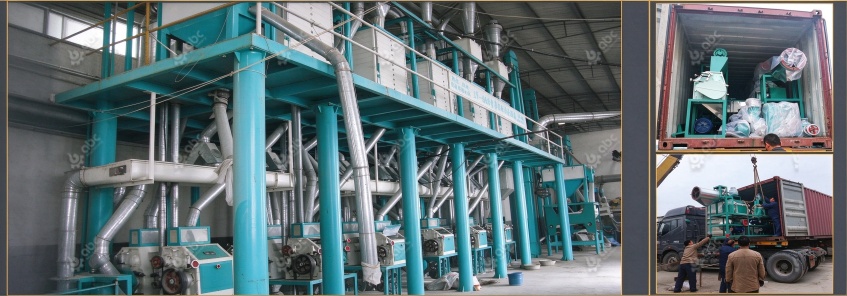
Complete Flour Milling Plant for Sale
Most small flour mill investment plans work better in two steps, and a flour mill machinery cost comparison across suppliers only means something once the six are aligned. Step one runs the line as a standard-flour plant: nine passages, no purifiers, manual-assisted packing. Step two adds purifiers and automatic packing once sales settle. The condition is that the layout reserves the space at the start — purifier positions, packing area and electrical headroom — because retrofitting those later without touching civil works is only possible if they were planned for. Build the building to the smallest possible size in step one and step two becomes a rebuild.
5. Comparing Capacities and Delivery
60 TPD sits where mismatches happen most often: buyers either look up to 100 TPD for a one-step solution or down to 40 TPD for sufficiency. The only test that matters is what flour will be sold, to whom, within three years — a question every flour miller answers differently and no wheat flour machine choice settles. Local bulk and staple flour suits 40 TPD; bagged retail flour going into shops or export needs 60 TPD as a starting point.
Table 3. Where four capacity rungs belong
|
Capacity |
Wheat flour mill machines |
Typical use |
Main constraint |
|---|---|---|---|
| 30 TPD | 5-6 units | Township processing, cooperative use | A shed will do, but grade ceiling is low |
| 40 TPD | 7-8 units | Local staple flour, bulk supply | A single destoner still has margin |
| 60 TPD | 9-12 units | Bagged commercial flour, regional brand | Destoner must go parallel; building needs a floor or a bay |
| 100 TPD and above | 15 units or more | Supermarket and export supply, multi-grade blending | Needs real flow design and central control; high civil and capital threshold |
On delivery, three questions come up every time: how long installation takes, who commissions the line, and who is called when something fails. At 60 TPD, installation and commissioning from equipment arrival to first flour normally runs several weeks, depending on whether the building is finished and the power supply is in place. The core of commissioning is tempering moisture calibration and flow adjustment, because the best settings differ between wheats and that stage cannot be skipped.
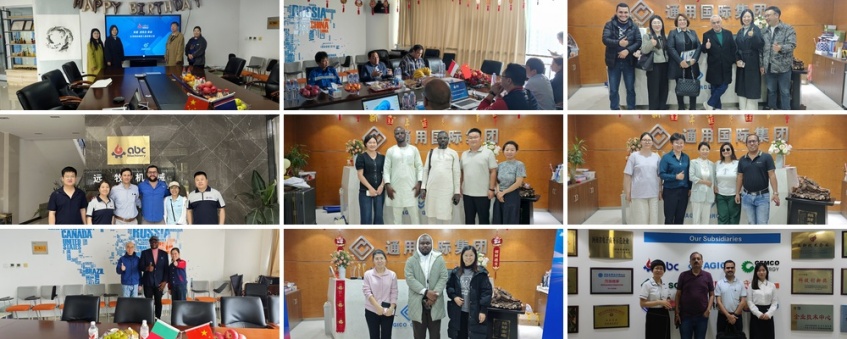
Foreign Customers Visit Flour Mill Machinery Factory
ABC Machinery builds flour milling equipment and integrates complete lines, with roller mills, plansifters, cleaning and conveying equipment manufactured in our own works, and process design, fabrication, shipping, installation, commissioning and training run by one team. At 60 TPD we usually issue a layout drawing and a configuration schedule before quoting: the drawing settles the floor-or-bay question, and every entry on the schedule carries its arithmetic — contact length, sieve area, installed power. Four inputs are needed: wheat type and origin, target grade, daily throughput and planned running hours, plus a floor plan if a building already exists. A buyer comparing flour mills for sale should ask for the same four from any wheat milling machine supplier before comparing any total.
Further reading: the wheat milling process, custom mill flow design, customised plant design, reconciling a quotation line by line, a test for choosing a manufacturer, a 20 TPD configuration, the 40 TPD project, the 120 TPD project and the 150 TPD plant in Bangladesh.
We receive enquiries in English, Español (Spanish), Русский язык (Russian), Français (French) and العربية (Arabic). Our professional team will reply to you within one business day. Please feel FREE to contact us!