139th Canton Fair 2026: Flour Mill Plant Buyers at Booth 8.1H48
The 139th Canton Fair held its Phase 1 in Guangzhou from 15 to 19 April 2026, and ABC Machinery received overseas buyers at booth 8.1H48 in the General Machinery and Mechanical Basic Parts section. A floor-type flour mill plant cannot be assembled inside a trade hall, so the stand carried the line as printed process panels, physical wear parts and a tray of finished-product samples.
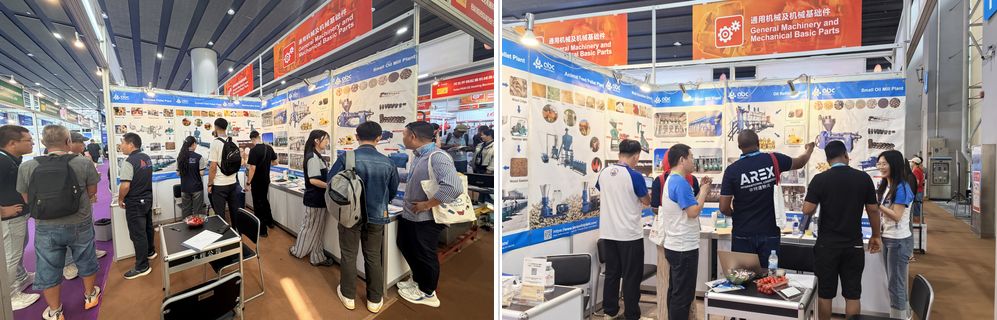
Booth 8.1H48 during Phase 1, under the orange banner issued for the General Machinery and Mechanical Basic Parts section.
For a buyer planning a flour mill, that constraint defines what the visit was worth. Not price. What could be fixed in the twenty minutes a buyer spends at a stand is the part of the specification that does not depend on the wheat in his own district: the order of the sections, which capacity band the project falls into, which machines sit inside the scope, and which of them change when the tonnage changes. Everything downstream of that — extraction rate, tempering time, roller gap, the layout of a six-floor frame — needs his grain and his building, and leaves the hall with him.
139th Canton Fair Phase 1: the numbers a flour mill buyer can use
Phase 1, themed Advanced Manufacturing, closed on 19 April with 167,000 overseas buyers, 5.9 percent above the previous session and the highest Phase 1 figure recorded. The phase occupied 520,000 m² across more than 25,000 booths, with more than 12,000 exhibitors in five sections and 19 exhibition areas. The full fair ran to 5 May and closed with 314,000 overseas buyers from 220 countries and regions, 1.1 percent above the 138th session.
|
Metric |
139th Fair (2026) |
138th Fair (2025) |
|---|---|---|
|
Phase 1 dates |
15–19 April 2026 |
15–19 October 2025 |
|
Phase 1 overseas buyers |
167,000 |
157,946 |
|
Phase 1 buyer growth |
5.9% |
6.3% |
|
Phase 1 exhibition area |
520,000 m² |
520,000 m² |
|
Phase 1 booths |
More than 25,000 |
More than 25,000 |
|
Full-fair overseas buyers |
314,000 from 220 countries |
More than 310,000 from 223 countries |
|
Full-fair buyer growth |
1.1% |
7.5% |
|
On-site intended export deals |
USD 25.7 billion |
USD 25.65 billion |
Sources: Canton Fair organizers and China Foreign Trade Centre, Phase 1 closing reported 19–20 April 2026 and full-fair closing reported 5–6 May 2026; 138th session comparison figures as reported by Xinhua on 20 October 2025 and China Daily on 5 November 2025. Figures rounded as published.

Booth 8.1H48: five sections on the wall, no roller mill in the hall
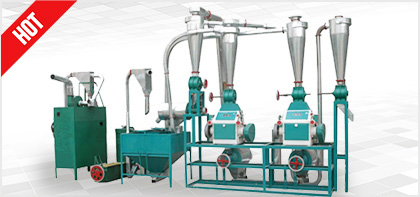
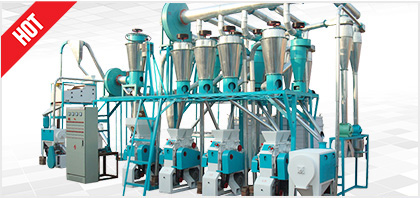
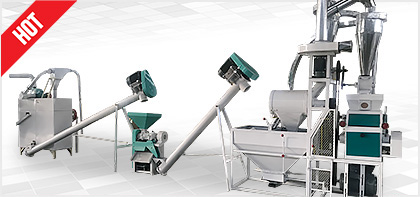
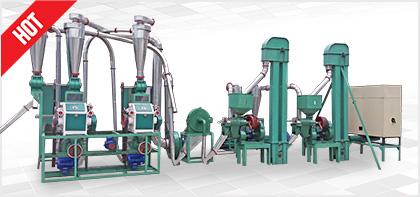
A shell-scheme stand holds a counter, two desks and four walls. Into that space a flour mill plant has to be compressed into drawings. The panel sequence displayed is the same one the plant is built from, and it maps directly onto the equipment list published on the products page: cleaning, milling, storage, PLC control and packing, eighteen unit types in total.
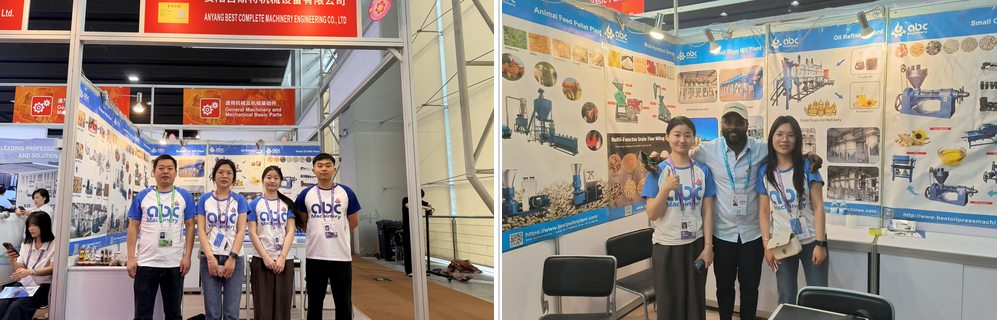
Buyers at the grain milling panel. The flow chart at the top of the panel is the same sequence the equipment list follows.
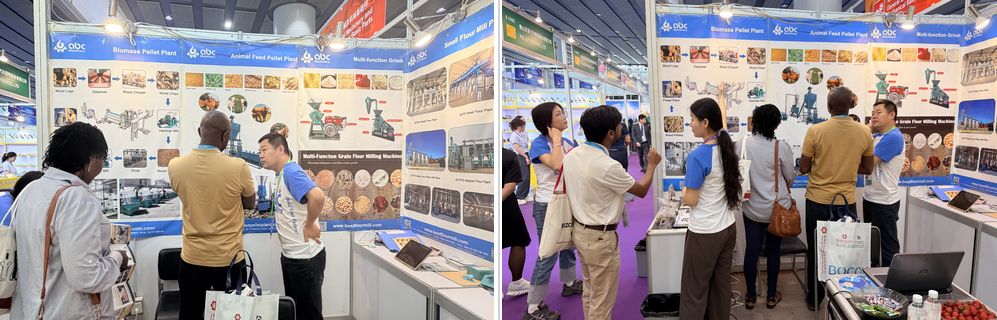
The stand team under the booth plate 8.1H48, with the section banner issued by the organisers.
Cleaning: ten units ahead of the first roller
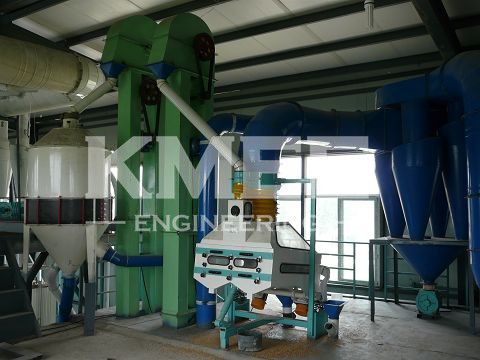
Cleaning is the section that decides how much ash ends up in the flour, and it is the section a low quotation trims first. Every tonne of wheat passes through it before reaching a roller mill. The published range runs from a pre-cleaning drum separator at 20–100 t/h on 0.75–2.2 kW, through a vibrating separator at 6–26 t/h, a gravity destoner at 1.5–23 t/h, a magnetic separator ahead of grinding, an air suction separator, a horizontal scourer at 5–25 t/h, a wheat washer at 1.5–9 t/h, a dampener and a wheat brusher at 3–16 t/h. Ten units, and a plant that omits three of them still calls itself a complete line.
Milling: five units that set extraction
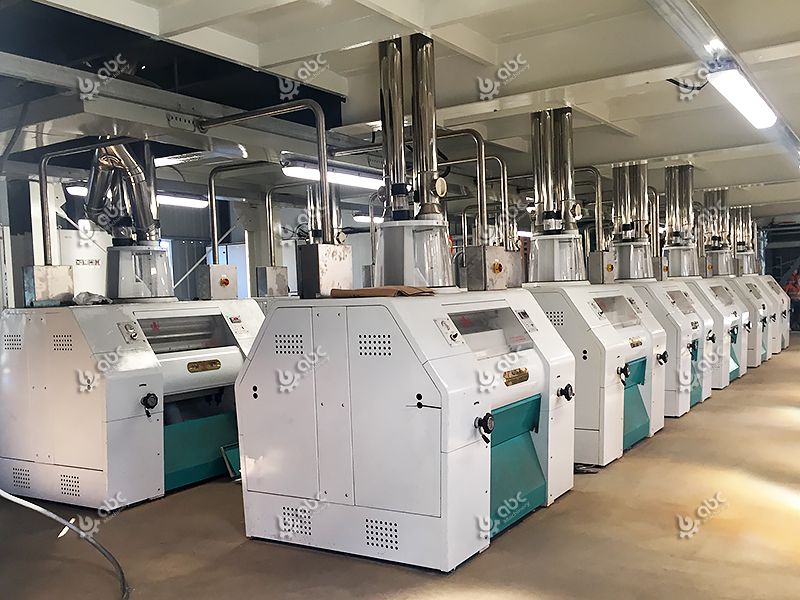
The pneumatic roller mill range covers FMFQ8×2 to FMFQ10×4 on 250–300 mm rolls; roll length and pair count set daily tonnage. The plansifter runs four to ten sections on 4–15 kW and separates ground stock into flour, semolina and bran. The purifier grades semolina on 0.4–5.6 t/h and is the unit that separates a longer milling flow from a short one. The impact detacher and the bran finisher, at 0.9–3.2 t/h, recover adherent flour from bran and act directly on yield.
Storage, PLC and packing: the three sections buyers treat as optional
The storage silo is buffer capacity between intake, milling and dispatch, and its volume is a commercial decision as much as an engineering one. The PLC system supervises weighing, feeding, grinding and packing as one sequence. The automatic packing machine covers DCS10, DCS25 and DCS50 at 3–4 bags per minute on 2.2 kW, filling 1–10 kg, 20–25 kg and 50 kg bags. These three sit outside the grinding line, which is exactly why they are the sections most often absent from a first budget and present in the second.
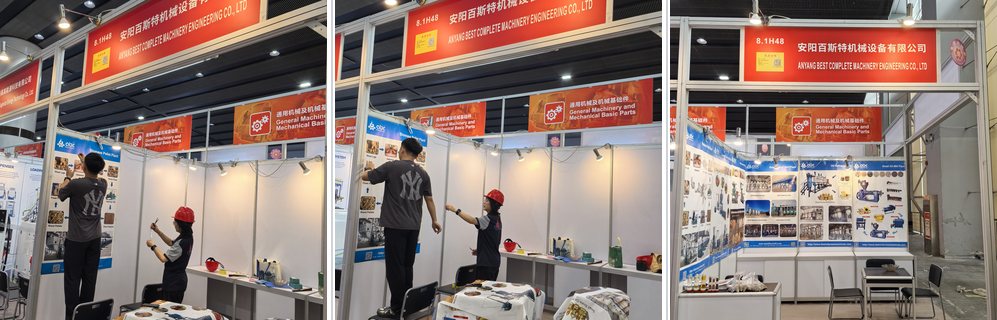
Build-up on 14 April 2026, the day before opening. Left to right — panels onto the frame; wall and lighting alignment; the counter set with sample trays.
What a stand visit settled, and what needed the buyer's own wheat
The four items below could be closed at the counter. The three beneath them could not, and no supplier who quotes them in a hall is quoting anything verifiable.
|
Item |
Settled at the stand |
Needed the buyer's data |
|---|---|---|
|
Section sequence |
Yes — cleaning, tempering, milling, sifting, packing; the order does not change with capacity |
— |
|
Capacity band |
Yes — which of the 10 to 200 t/d bands applies, and therefore which roller mill series |
Exact output follows a wheat sample test |
|
Scope of the plant |
Yes — whether silo, PLC and packing are inside the package or left to the buyer |
Final scope follows the site survey |
|
Wear parts |
Yes — roller shells, screens and hammers were on the counter and could be measured |
Wear rate follows the ash and grit in the wheat |
|
Quotation |
No |
Grain, daily tonnage, running hours, flour grade |
|
Layout drawing |
No |
Building dimensions, floor count, available height |
|
Extraction rate |
No |
Milling test on the actual wheat |
The conversion that causes most of the confusion at a stand is between daily tonnage and hourly machine rating. Buyers arrive quoting tonnes per day; the equipment tables quote tonnes per hour. The arithmetic is t/h = t/d ÷ running hours per day, so a 50 t/d plant on a 20-hour shift needs machines rated at 2.5 t/h, not 50. A buyer who reads the capacity column as daily output will size every machine in the plant wrong by a factor of twenty.
|
Plant size |
At 20 h/day |
At 24 h/day |
Roller mill scale |
|---|---|---|---|
|
10 t/d |
0.50 t/h |
0.42 t/h |
Single small mill |
|
30 t/d |
1.50 t/h |
1.25 t/h |
Compact multi-pass |
|
50 t/d |
2.50 t/h |
2.08 t/h |
Standard multi-pass |
|
100 t/d |
5.00 t/h |
4.17 t/h |
Standard multi-pass |
|
200 t/d |
10.00 t/h |
8.33 t/h |
Large multi-floor line |
Cleaning capacity is normally sized above the milling rate, because the cleaning house has to stay ahead of the mill during the hours it runs. How far above depends on the grain and on the cleaning shift length, and it is fixed per project rather than by rule of thumb.
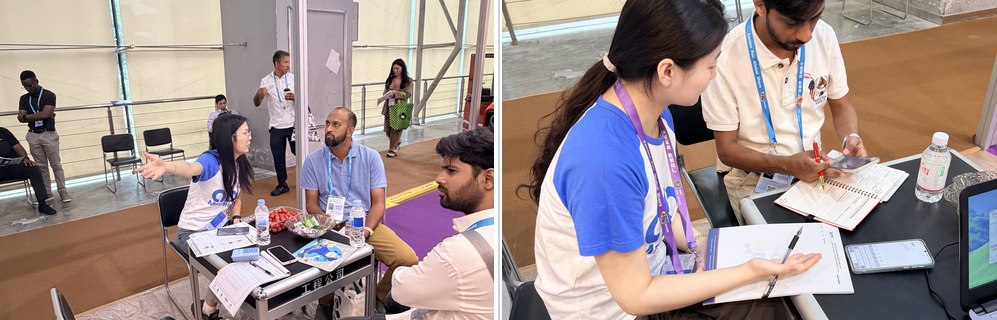
Consulting desks during Phase 1, with documents between buyer and engineer.
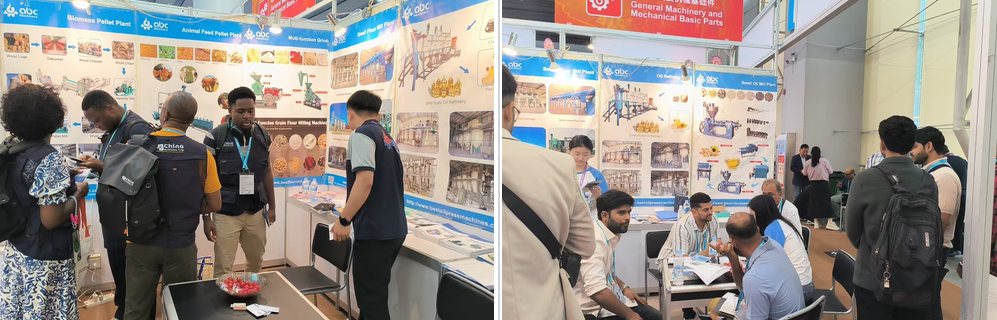
Catalogue review at the counter, where the printed capacity tables sat beside the physical samples.
From 120 to 160 t/d: how the line is rebuilt at each step
The three delivered plants below sit inside the range most enquiries at the stand were about, and each shows a different constraint being solved rather than a larger version of the same drawing.
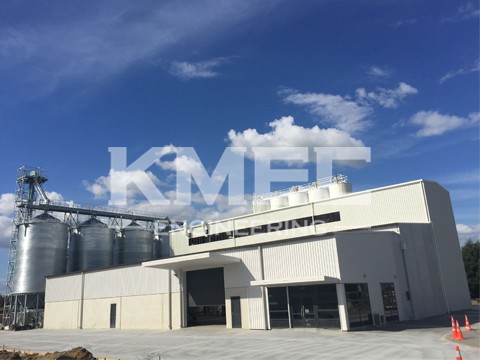
The 120 t/d flour mill plant in India is a question of throughput against building footprint. The 150 t/d plant in Bangladesh is a question of wheat supply and market grade in a dense milling market. The 160 t/d plant in New Zealand is a question of automation: the line runs under whole-plant PLC control, which changes the labour structure as much as the equipment list. A fourth reference, the 50 t/d maize mill, sits at the other end of the same logic, because maize and wheat need different cleaning and different roll settings and therefore different machine lists at the same tonnage.
Reading them side by side is the reason a single price per tonne of capacity does not exist. Between 120 and 160 t/d the section sequence is identical and almost no equipment specification is shared: roller length, sifter sections, purifier count, silo volume and control architecture all move. The 100 t/d dual-line project in Burkina Faso shows the same point from the construction side, where steel structure, layout and local standards were engineered together rather than after the machines were chosen.
After the fair: process design, layout and factory visit
The stand closed on 19 April 2026 and was dismantled. The work that follows does not depend on having attended, and it runs in the same order whether or not a buyer walked the hall: a milling test on the actual wheat, an equipment list derived from the test, a layout drawn against the building, then manufacture, shipment and commissioning. The steps are set out on the service page, and the process behind them in the wheat milling process guide.
Factory visits in Anyang can be arranged, and a video walkthrough of a running line is available before a visit is committed. Buyers who want the equipment list for a specific capacity can send the four inputs below through the contact page.
Four inputs decide the equipment list: the grain, the daily tonnage, the running hours per day, and the flour grade the market requires. Send those four and the reply names the machines with model numbers and power draw, rather than a plant size and a price range.
- When was the 139th Canton Fair held?
- 15 April to 5 May 2026 in Guangzhou, in three phases. Phase 1, for industrial machinery, ran from 15 to 19 April and drew 167,000 overseas buyers, 5.9 percent above the previous session.
- Where was the ABC Machinery booth?
- Booth 8.1H48, in the General Machinery and Mechanical Basic Parts section of Phase 1.
- Can a flour mill plant be inspected at a trade fair?
- No. A floor-type plant occupies several storeys and cannot be assembled in a hall. The stand carries the process panels, wear parts and finished samples; the machines themselves are inspected at the factory in Anyang or through a video walkthrough of a running line.
- What can be decided at the stand and what cannot?
- The section sequence, the capacity band, the scope of the plant and the specification of wear parts can be closed at the stand. Quotation, layout drawings and extraction rate cannot, because each depends on the buyer's wheat or his building.
- What capacity range does ABC Machinery build?
- Flour mill plants from 10 t/d to 200 t/d are covered by the published equipment tables, and larger lines are configured per project. Delivered references in the range include 50, 100, 120, 150 and 160 t/d plants.
- Does the plant price depend only on daily tonnage?
- No. Between 120 and 160 t/d the section sequence is the same but roller length, sifter sections, purifier count, silo volume and control architecture all change. Grain type changes the cleaning section and the roll settings at identical tonnage.
- How are daily tonnage and machine capacity related?
- By the running hours per day: t/h = t/d ÷ hours. A 50 t/d plant on a 20-hour shift needs machines rated at 2.5 t/h. Equipment tables quote hourly capacity, so daily figures have to be converted before a machine is selected.
We receive enquiries in English, Español (Spanish), Русский язык (Russian), Français (French) and العربية (Arabic). Our professional team will reply to you within one business day. Please feel FREE to contact us!